In 2026, freight elevators remain essential in warehouses, factories, hospitals, retail centers, and distribution facilities. Yet “standard” does not mean one universal weight rating. If you ask, “what is the weight capacity of a standard freight elevator,” the honest answer is: it depends. Many common freight elevators support between 2,000 and 10,000 pounds, while specialized models can carry much more. Capacity depends on car dimensions, door width, loading equipment, building structure, travel distance, and intended use.
This guide explains how professionals evaluate freight elevator capacity before installation or daily operation. A compact warehouse elevator may handle several loaded pallets, while a heavy-duty industrial model may move machinery, carts, or vehicles. Picture a pallet jack entering a steel car, with only inches of clearance near the doors. That space affects safe loading. The rated capacity also includes people, pallets, carts, and cargo together. It is not cargo weight alone.
Reliable decisions should begin with the elevator data plate, manufacturer specifications, and a qualified inspection. Applicable standards, such as ASME A17.1/CSA B44, support safer design and maintenance practices, but local requirements may vary. This article compares common capacity ranges, explains key rating terms, and identifies warning signs of overloading. Some online charts look precise. They are not always enough. Real projects can expose assumptions that seemed reasonable on paper. A careful review remains essential before selecting equipment or changing its intended service.
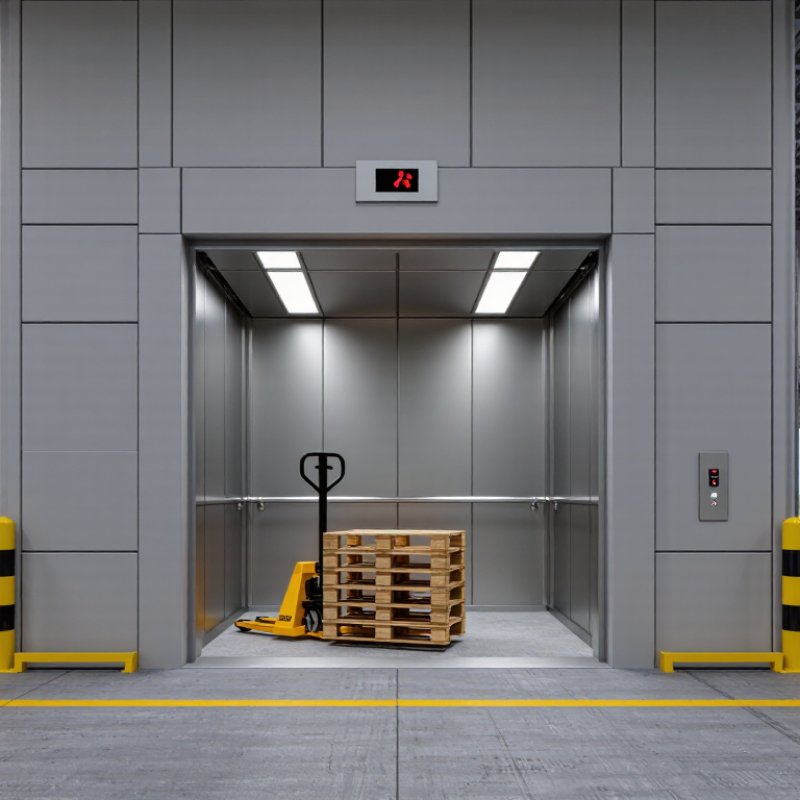
Freight Elevator Weight Capacity: Definition and Core Specifications
Freight elevator weight capacity is the maximum rated load the elevator can safely transport. It includes people, pallets, carts, and products inside the car. Capacity is usually stated in kilograms or pounds. A 2026 specification should match the building’s real handling needs, not an attractive number on a brochure.
Core specifications
include rated capacity, car dimensions, door width, lifting speed, travel height, and loading frequency. A 2,000-kilogram elevator may suit warehouses using standard pallets, while heavier manufacturing equipment may require 3,000 kilograms or more. Car depth matters too. A wide door cannot solve an elevator car that is too short. Floor strength, loading-point alignment, and turning space also affect daily performance. They are easy to overlook.
Field assessments often reveal a practical problem: the planned load is lighter than the equipment used to move it. A pallet truck, steel cage, or protective frame can consume hundreds of kilograms. No chart replaces a site check. Engineers should verify concentrated loads, stopping accuracy, door operation, and duty cycles against applicable local codes. Independent inspection records add useful reliability. I would also question any capacity claim without a clear test basis. Rated capacity is not a suggested target. Leaving operating margin reduces strain, but excessive capacity can raise construction and energy costs without real benefit.
Standard Capacity Ranges for Common Freight Elevator Classes
2026 Best Standard Freight Elevator Weight Capacity?
The word “standard” is misleading. Freight elevators usually range from 2,000 to 20,000 pounds, or about 900 to 9,100 kilograms. Market analyses from Grand View Research and Mordor Intelligence identify these bands as common commercial specifications, though published ranges vary by region and building type. Smaller Class A units often serve warehouses and retail backrooms. They commonly carry 2,000–6,000 pounds. Larger industrial models may support 10,000–20,000 pounds or more.
Loading class matters as much as rated capacity. Under ASME A17.1/CSA B44, Class A freight loading generally limits each load to a portion of the rated capacity. Class B supports motor-vehicle loading, often around 50% of rated capacity. Class C industrial truck loading may allow heavier concentrated loads, depending on the specific classification and design. EN 81-20 provides separate safety and design requirements for many international installations. It does not create one universal “standard” weight.
A 10,000-pound elevator may still fail a practical assessment if pallet wheels, forklifts, or uneven loads concentrate pressure. I would not select equipment from capacity alone. Review pit depth, door width, cab dimensions, loading frequency, and local inspection rules. The weak point is often the loading pattern, not the number on the data plate. Check the site conditions.
2026 Best Standard Freight Elevator Weight Capacity
Typical capacity ranges for common freight elevator categories. Capacities are shown in pounds and represent general commercial planning ranges rather than universal code classifications.
Light-duty freight elevators commonly handle about 2,000–4,000 lb, while heavy and industrial units may be designed for 10,000–20,000 lb. Final capacity depends on building codes, car dimensions, loading methods, travel requirements, and the selected elevator design.
How Building Use and Load Types Affect Capacity Selection
2026 Best Standard Freight Elevator Weight Capacity?
A “standard” freight elevator has no universal weight rating. Common capacities range from 2,000 to 20,000 pounds, but building use should decide the final specification. A small retail building may need 2,000–4,000 pounds for cartons and hand trucks. A distribution facility may require 6,000–10,000 pounds for loaded pallets. Heavy manufacturing can demand more.
Load type matters as much as total weight. A dense steel coil creates concentrated floor pressure. A pallet jack creates rolling impact at the entrance. Uneven loads can also shift during travel. ASME A17.1/CSA B44 requires clear rated-load information and defines freight loading conditions. Engineers should also check door width, platform size, pit depth, and shaft space. A 5,000-pound rating may still be unsuitable for a long, narrow machine.
MHI’s 2024 Annual Industry Report found that 83% of supply-chain professionals were concerned about hiring and retaining qualified workers. That detail matters. Simple controls, visible load limits, and practical training reduce loading mistakes. I would not select capacity from today’s average shipment alone. Growth, heavier packaging, and future equipment can change the demand.
Tips: List every load type, including pallets, carts, vehicles, and machinery. Measure the heaviest item and its footprint. Ask a licensed elevator engineer to review floor loading and loading class. Keep a margin, but avoid paying for unused capacity. Overspecification is not always better.
Choosing the Right Freight Elevator Capacity in 2026
Choosing the Right Freight Elevator Capacity in 2026
Selecting a freight elevator begins with the real load, not the largest available rating. Industry specification data in Elevator World’s 2024 Product Guide places many standard freight units between 2,000 and 10,000 pounds. Heavy-duty designs can exceed 20,000 pounds. These figures provide useful benchmarks, but they do not replace a site survey. Pallet dimensions, loading equipment, travel distance, and door width can change the practical requirement.
A warehouse moving 6,000-pound pallets may need a 10,000-pound elevator. The extra margin protects the equipment and reduces scheduling problems. It also allows space for carts, packaging, and unevenly distributed cargo. Do not overlook floor loading. A dense steel component can stress the car floor even when the total weight remains acceptable. ASME A17.1/CSA B44 requires structural, safety, and operational provisions, but local authorities may apply additional criteria. Check them early.
Real operating patterns matter. A distribution center may need faster cycling, while a manufacturing site may prioritize deep cars and reinforced entrances. Oversizing can increase construction cost, pit depth, and energy use. Undersizing creates delays and unsafe workarounds. I would measure the heaviest routine shipment, not the occasional extreme case. That judgment can be imperfect. Review maintenance records after installation, then adjust future capacity planning with actual load data.
Conclusion
A standard freight elevator is designed to move heavy goods, equipment, and materials rather than passengers, with its rated capacity determined by the car size, lifting system, structural design, and intended operating conditions. When asking, “what is the weight capacity of a standard freight elevator,” the answer depends on its class and application. Common capacities may range from several thousand pounds for light-duty units to well over 10,000 pounds for heavy-duty installations. The correct choice should reflect the typical and maximum loads, not simply the average shipment weight.
Building use and load type are equally important. Warehouses may require high capacity and durable interiors, while commercial or industrial facilities may need wider doors, reinforced floors, or space for carts and machinery. Safety standards, balanced loading, door dimensions, travel distance, emergency systems, and building structure can limit the usable rated weight. In 2026, selecting the right freight elevator capacity means evaluating current demand, future growth, loading practices, and professional engineering requirements to ensure reliable, efficient, and safe operation.
 Keg Lift
